
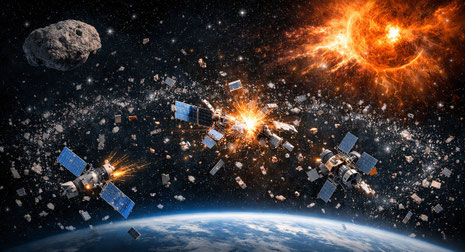
The updated assessment of asteroid 2024 YR4 provides reassurance regarding one specific scenario: a lunar impact in 2032 is now effectively negligible. However, this should not be interpreted as a reduction in overall orbital risk. On the contrary, the structural conditions that enable the Kessler syndrome continue to intensify. The primary risk is not just a singular external event, but the increasing fragility of an overcrowded orbital environment. External triggers, whether from smaller asteroids or extreme solar activity, remain potential catalysts. Yet even without them, the probability of a collision cascade is gradually increasing. Understanding and mitigating this risk will require a shift from event-based thinking to systemic risk management in Earth’s orbital domain.
Asteroid 2024 YR4: Reassessing the Risk Landscape
Recent analysis has significantly reduced the estimated probability of asteroid 2024 YR4 impacting the Moon in 2032. While earlier discussions considered a non-zero likelihood of lunar collision and its potential implications for orbital debris, updated orbital solutions now indicate that such a scenario is effectively negligible. This reflects improved tracking accuracy, longer observation arcs, and better modeling of orbital perturbations, all of which contribute to narrowing uncertainty bands around the asteroid’s trajectory.
The removal of this specific risk scenario is important, but it should be interpreted carefully. It eliminates a discrete, high-visibility event that could have acted as a catalyst for orbital disruption, yet it does not materially change the underlying risk profile of Earth’s orbital environment. In other words, while one potential trigger has been ruled out, the system itself remains increasingly fragile.
This distinction highlights a broader shift in how orbital risks should be understood. Rather than focusing on singular events with dramatic outcomes, attention must increasingly turn to structural dynamics such as orbital congestion, object interaction rates, and cumulative instability. These factors are less visible but ultimately more consequential in shaping long-term risk.
The Real Risk: Increasing Orbital Density
Low Earth Orbit (LEO) is undergoing rapid densification. The continued deployment of large satellite constellations, combined with legacy debris, has created an environment where the margin for error is steadily shrinking.
Even in the absence of external triggers, this growing density increases the probability of spontaneous collision cascades. The underlying mechanics are well understood: as object density rises, the likelihood of collisions increases nonlinearly, and each collision generates additional debris, further amplifying the risk. This dynamic is at the core of what is known as the Kessler syndrome.
Kessler Syndrome as a Systemic Risk
The Kessler syndrome describes a scenario in which collisions between objects in orbit generate debris that increases the likelihood of further collisions, potentially leading to a self-sustaining cascade. While often framed as a theoretical extreme, its underlying dynamics are already visible today, with fragmentation events demonstrating how rapidly debris can proliferate and persist in critical orbital regions.
The core challenge lies in the feedback loop created by debris accumulation. Even small fragments, traveling at orbital velocities, can cause severe damage, and as their number increases, so does the probability of additional collisions. Unlike terrestrial systems, there is no efficient mechanism to remove debris quickly, especially at higher altitudes where decay times are long. Beyond a certain density threshold, traditional mitigation measures such as collision avoidance and deorbiting may no longer be sufficient to stabilize the system.
Crucially, this transition toward instability does not require a single catastrophic trigger. It can emerge gradually as orbital density and interaction rates increase. External events such as small asteroid impacts or extreme solar storms may accelerate the process, but the risk is fundamentally systemic. The Kessler syndrome should therefore be understood not as a distant scenario, but as a continuum of increasing orbital fragility that demands proactive management.
External Triggers: Still Relevant
Although asteroid 2024 YR4 is no longer considered a credible threat to the Moon, external triggers remain a valid concern.
- Small Asteroid Interactions - Even relatively small objects, if intersecting with densely populated orbital shells, could generate localized debris fields. In a sufficiently dense environment, this may be enough to initiate a cascade, particularly if collisions occur within critical altitude bands heavily populated by operational satellites.
- Extreme Solar Storms - A more systemic external trigger is an extreme solar storm. Events comparable to the Carrington Event can significantly impact satellite operations. Such storms can induce increased atmospheric drag variability, disruptions in onboard electronics, loss of attitude control or navigation precision. In aggregate, this could lead to multiple satellites deviating from their intended orbits simultaneously. Even small deviations, when scaled across large constellations, increase the probability of conjunction events and potential collisions.
From Isolated Events to Systemic Vulnerability
The dominant narrative around space risk has traditionally centered on isolated external shocks, such as asteroid impacts or major satellite failures. While such events remain relevant, they are no longer the primary drivers of risk in Low Earth Orbit. Instead, the system is evolving toward a state where internal dynamics, driven by density and interaction frequency, become the main concern.
As orbital shells become more crowded, the probability of collision increases nonlinearly. Each additional satellite not only adds to the total count but also increases the number of potential interaction pairs. This creates a network effect where risk scales faster than the number of objects in orbit. Over time, this leads to a condition where even minor perturbations or small failures can propagate through the system.
In this context, systemic vulnerability emerges not from a single catastrophic event, but from the accumulation of small risks across a highly interconnected environment. The Kessler syndrome
represents the extreme manifestation of this process, but the transition toward instability can begin well before a full cascade develops. This makes early detection, monitoring, and mitigation
increasingly critical.
Implications for the Space Economy
The consequences of increasing orbital fragility extend far beyond the space sector itself. Modern economies rely heavily on space-based infrastructure for communication, navigation, weather forecasting, and Earth observation. As a result, disruptions in orbital stability can have cascading effects on critical services and industries on the ground.
A significant increase in collision frequency, or even the perception of heightened risk, could alter the economics of satellite deployment and operation. Insurance costs may rise, mission lifetimes could shorten, and regulatory constraints may tighten. This would directly impact the business models of satellite operators, particularly those relying on large constellations in Low Earth Orbit.
More broadly, a degradation of the orbital environment could limit future access to space. Launch windows may become constrained, operational altitudes restricted, and debris avoidance maneuvers more frequent and complex. In this scenario, the space economy shifts from a growth-driven paradigm to one focused on risk management and sustainability, with long-term implications for innovation and global connectivity.
Would you like to get more information on the topic?
Interested in custom space technology analysis & forecast?


Write a comment