This report overviews the 2024-25 developments in the Israeli electricity market with emphasis on the power generation segment. The deployment progress in renewables continued to slow down, especially in the second half of the year and in early 2025 due to security crisis. In terms of conventional generation, the market mainly followed the implications of the Electricity Reform, continuing to transfer Natural Gas-powered generation from the Israel Electric Corp to the private segment and preparing to retire old coal units in the Hadera power plant in 2025-26. By the end of 2024, Israeli national electric generation capacity stood at 24.7 GWp, with private producers (IPPs) making up 61.7% of total grid-connected capacity and Israel Electric Corp (IEC) making up the remaining 38.3%. By the end of 2025, the market capacity is expected to rise to 27.2 GWp. In terms of electricity generation in the Israeli market, the upward trend continued from 77.4 million kWh in 2023 to 80.4 million kWh in 2024 and is expected to reach 81.9 million kWh in 2025. The 2024 generation segment was relying on a mix of fuels, dominated by natural gas and coal - both utilized by the Israel Electric Corp (IEC) as primary fuels. Secondary fuels of the IEC were diesel, oil fuel and methanol. Private power generation facilities were primary relying on natural gas, while diesel, oil fuel, kerogen and renewables were secondary energy sources. Notably, renewables reached an 13.6% share of market supply in 2024 (slightly above LNRG's projected 12.8%) and are expected to reach 15.6% in 2025, primarily driven by solar PV generation.
From early 2000s and until early 2020s, the Israel Electric Corporation (IEC) had been denied from building new conventional power plants, thus practically all capacity additions during the period had been made by the private sector. Moreover, upon the Electricity Market Reform, the IEC was forced to sell several of its generation units, whilst enabling it to upgrade some of its units in the future. The IEC capacity further reduced upon retirement of several generation units in 2019 and privatization of three compounds in 2019 and 2020 respectively; another IEC site of Hagit completed the privatization process in December 2021, followed by Eshkol in 2024 and then additional compounds in the second half of 2020s. In 2023, the IEC completed the complementary Natural Gas-powered unit 70 at the Orot Rabin site, replacing the retiring coal units beginning on January 2025. IEC's Unit 80 at the Orot Rabin site is expected to go online on late 2025 or early 2026, completing the replacement of coal units 1-4. During 2024-25, the deployment progress in renewables continued at the pace of about 1.0 GW/year, though had slightly decreased due the regional security crisis.
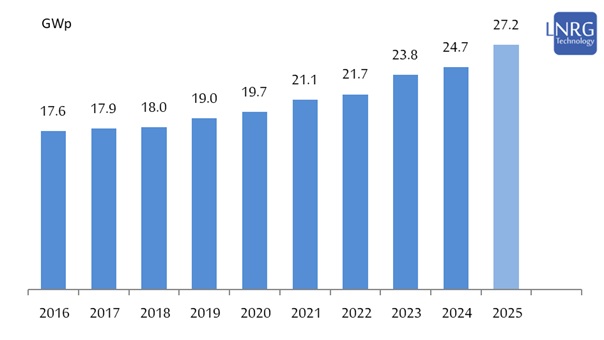
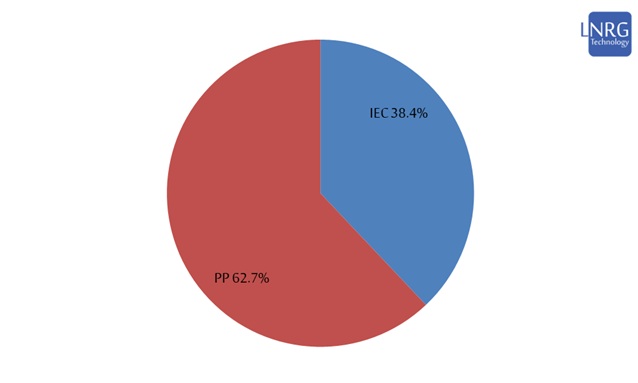
The eruption of regional war in October 2023 affected the deployment rate of new power plants in 2024 and 2025, primarily delaying multiple projects and notably cutting the Israeli electricity supply line to the Gaza Strip. Despite it, about 0.9 GWp of new capacity was added in 2024, mostly distributed solar PV. In 2025, the new capacity deployment rate is expected to increase with about 2.5 GWp net additions, including mostly conventional generation whilst keeping the renewables addition rate. By the end of 2024, Israeli national electric generation capacity stood at 24.7 GWp, with private producers (IPPs) including renewables making up 61.7% of total grid-connected capacity and Israel Electric Corp (IEC) making up the remaining 38.3%. By the end of 2025, the market capacity is expected to rise to 27.2 GWp. The private power generation segment, including renewables, has surpassed the one half share of the market capacity in the beginning of this decade and is expected obtain about 62.5% share in 2025 and 72% share by 2026.
In terms of conventional generation, several power plants began continuous operation: The 630 MWp IEC Natural Gas generation Unit 70 at the Orot Rabin site was connected in late 2023 and synchronized in January 2025; the Kokhav Yarden 344 MWp pump accumulation project was connected in 2024 and synchronized in February 2025; the Etgal Power Plants project was connected in 2024 and synchronized in May 2025; the MRC Alon Tavor 230 MWp peaker power plant began operating in October 2025; the IEC Natural Gas generation Unit 80 at the Orot Rabin site is expected to connect at the end of 2025 or early 2026. On the other hand, the 43 MWp Haifa Refineries Power Plant operation was arrested in June 2025 due to damage from Iranian rocket attacks, requiring a complete reconstruction of the site. Among renewable projects, the 156 MWp Teralight's Taanach 1 project was connected in August 2024 and synchronized in January 2025; and Enlight's 82 MWp Arad Valley was completed during 2023-24 period. Hydropower capacity remained stable in 2024 and is not expected to change in 2025 beyond eight existing facilities, with ninth facility in the planning stage. Furthermore, no small-scale biogas plants were added in 2024 on top of the fourteen existing and none are planned to connect during 2025. Overall, 64 utility-scale high-voltage power plants contributed to Israel's electricity generation segment as of December 2024 and this is expected to grow to 68 power plants by December 2025. As of 2024, utility-scale conventional and renewable power plants represented 76% of installed capacity, which is gradually declining upon delpoyment of distributed solar power.
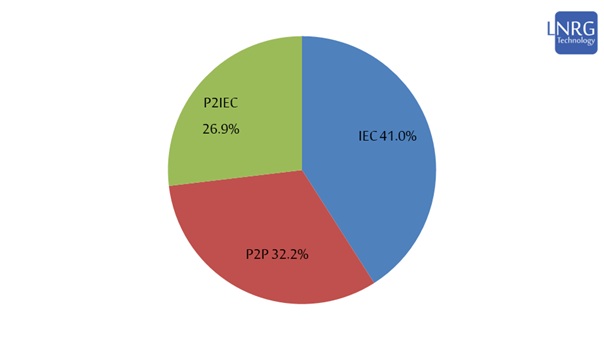
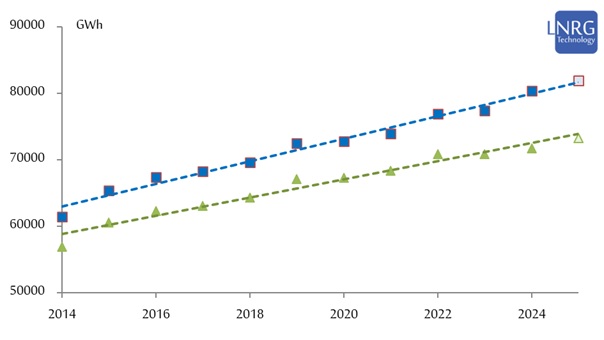
In terms of electricity market generation and supply, 76.9 million kWh were produced in 2022, 77.4 million kWh in 2023, 80.4 million kWh in 2024 and 81.9 million kWh is expected to be generated in 2025. Through 2024, IEC produced 41.0% of electricity supply and added with electricity purchased from private producers, the IEC altogether controlled 67.8% of total electricity supply, whereas the remaining 32.2% consisted of output supplied by private producers directly to customers, power purchase agreements (PPAs) or schemes of self-consumption (small PV producers and four conventional power plants). Private generation share hence surpassed the 50% margin during 2023 and grew strongly through 2024 with almost 60%, expected to further progress in 2025. This aligns the Israeli market with the electricity reform target of 60% private electricity generation output by 2025.
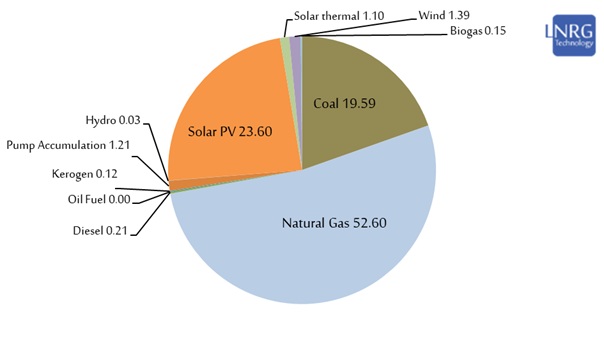
In 2024, the power generation segment was relying on a mix of fuels, dominated by natural gas and coal - both utilized by the IEC as primary fuels. Secondary fuels of the IEC were diesel, oil fuel and methanol. Private generation facilities were primary relying on natural gas, while renewables, diesel and oil fuel were secondary energy sources. When combined, the electricity generation segment continued to be dominated by natural gas as the primary energy source (52.6% by capacity), secondary were renewables (combined 26.1% by capacity) – predominantly solar PV technology (23.8% by capacity), as well as smaller capacities of solar thermal, wind, biogas and hydro, and the third place taken by coal (19.6% by capacity). Pump accumulation accounted for another 1.2% of capacity, while other fossil fuels contributed a tiny 0.3% fraction of total capacity. By December 2025, the capacity by fuel ratios is expected to be at 54.1% natural gas, 15.7% coal, 27.4% renewables, 2.4% pump accumulation and other fossil fuels at 0.3%.
In 2024, the largest share of electricity generation was obtained by natural gas and coal, similar to their dominance in installed capacity. Notably, renewables reached a 13.6% share of market supply in 2024 (slightly above LNRG's projected 12.8%) and are expected to reach 15.7% in 2025, primarily driven by solar PV generation.
In the past, the Electricity Authority estimated that the growth in electricity demand during the second and third decades of the 21st century is to be at 2.7% annually, which is slightly above the average Israeli demographic growth rate of ~2.0%. However, in reality, the growth of electricity demand has somewhat been lower - at an average pace of just +1.3% annually over the past five years: at +0.2% in 2020, at +1.6% in 2021, at +3.6% growth in 2022, at +0.1% in 2023 and at +1.1% in 2024. The ten year-average electricity demand growth was +2.4% annual, which is still lower than previously expected. There is indeed a total electricity demand growth due to demographic expansion and another contributing element being the wide-spread adoption of electric vehicles and other electrical transportation means including electrification of light rail and heavy rail. However, increasing efficiency of electricity consuming devices, such as air conditioners, and introduction of self-consumption in private homes and businesses are set to push the demand growth in the opposite direction. Hence, the annual national growth rate of electricity demand is likely to continue and be in he range of +1.0-1.5%.
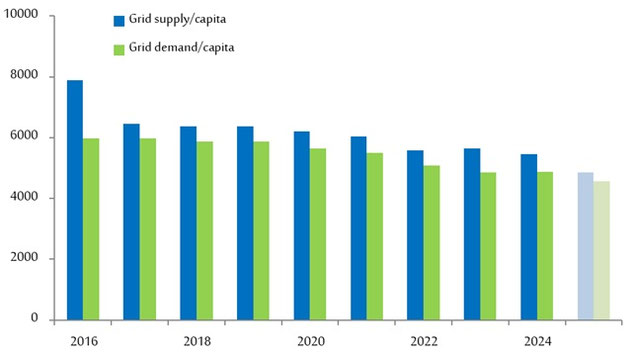
Grid supply per capita (excluding peer-to-peer deals) has generally decreased over the past decade in line with the decrease in grid demand per capita. The grid supply went from 6.4 thousand kWh in 2019 to 5.6 thousand kWh in 2023, and 5.5 thousand kWh in 2024. The electricity demand per capita (excluding peer-to-peer deals) also decreased from 5.9 thousand kWh annual in 2019 to 4.9 thousand kWh in 2023 and the same figure in 2024. Total electricity supply per capita in Israel was at 8.0 thousand kWh annual in 2019, has remained about the same at 7.9 thousand kWh in 2023 and 8.0 thousand kWh in 2024. Total electricity demand per capita in Israel was at 7.4 thousand kWh in 2019, slightly decreasing to 7.2 thousand kWh in 2023 and the same figure in 2024.
The transmission and distribution segments continued to be controlled by the IEC. Following the adoption of the Electricity Reform, in 2019 the grid control department was split into a separate company named Noga and received operation license in June 2020. Distribution segment has about 10% share licensed to the Kibbutzim agricultural communities and the rest controlled by IEC; more players are entering this segment as virtual providers upon the implementation of the market reform. Notably, in 2021 it was announced that 22 players would enter the distribution segment under this framework and began operating. It increased to 34 players during 2022, 45 players in 2023, 46 players in 2024 and 49 players as of 2025.
The off-grid electricity market in Israel is essentially small, estimated at only several dozen megawatts deployed in desolate locations, including diesel generators and solar PV collectors. There are four major off grid facilities for self-consumption - the Noble Energy Mediterranean 31.85 MVA offshore generation unit at the Tamar gas field, the Rotem Amfert 16.7 MWp generation unit, the Ben Gurion Airport 12.4 MWp facility and the Nesharim Energy 2014 facility rated 48.3 MWp.
The extended commercial report and premium member data page access can be purchased at the LNRG Technology digital store.